"Portent, Target You." Rethinking UW's Thoughtseize
As Legacy's resident Miracles mage, I'm constantly thinking about how to use cards in new ways while staying within the format's guardrails.
At the time of this article's publication, {Wasteland} is present in more than half the decks comprising the metagame, which hampers playing more than two colors. Miracles is base [u][w], but more often than not, my need to solve a specific problem does not exist in those colors.
Most of [u][w]'s tools are [u]'s countermagic and [w]'s removal. There are, however, many tools that obsolete countermagic, including {Cavern of Souls}, {Veil of Summer}, {Hexing Squelcher}, {Allosaurus Shepherd}, {Teferi, Time Raveler}, {Mistrise Village}, {Kaito, Bane of Nightmares}, or ignore it, like {Urza's Saga} or cast triggers (e.g., Eldrazi, {Ugin, Eye of the Storms}.
I often yearn for {Thoughtseize} or {Duress} to get ahead of those countermagic-blanking/ignoring cards or massive haymakers like opposing Planeswalkers or {The One Ring}, but meaningfully splashing a third color requires too much exposure to {Wasteland}. What are honest [u][w] mages to do?
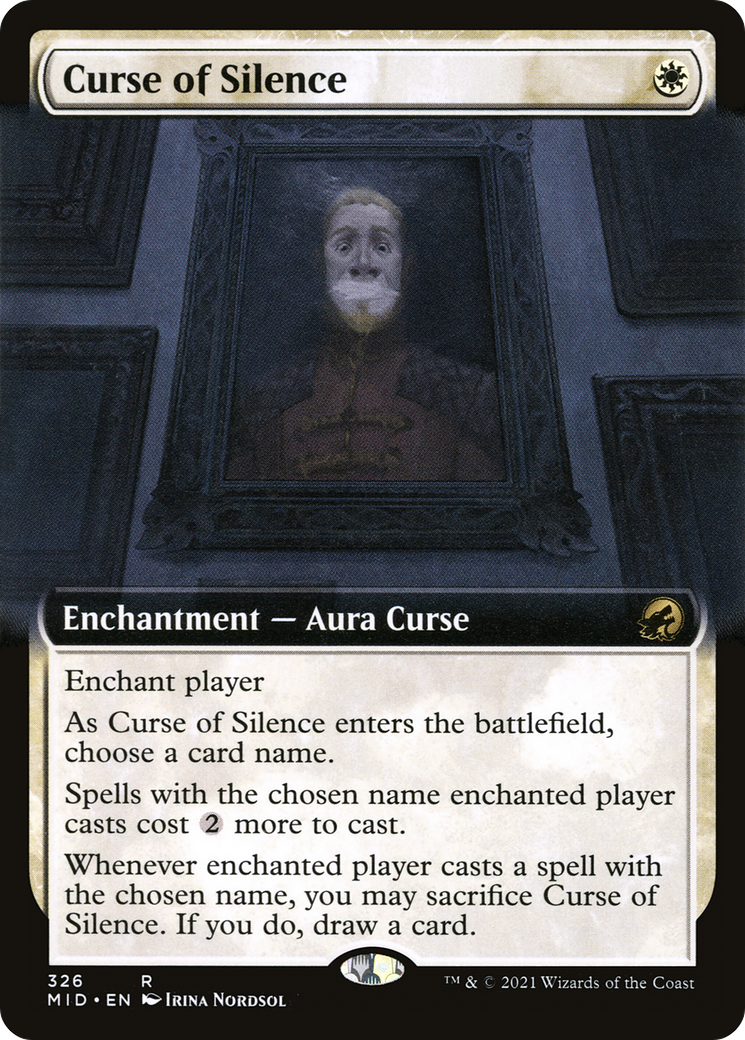
I've tested {Curse of Silence} before. Printing a taxing effect like this on a one-mana spell instead of its typical 3+ mana alternatives (e.g., {Anointed Peacekeeper}, {Elite Spellbinder}) is likely about as close to a bleed as [w] can get to discard-esque effects. While it pays you back the card off its cantrip if they pay the tax, if the goal is to prevent the spell rather than tax mana, {Curse of Silence} is insufficient. It would be most potent with early, aggressive pressure, which steers into wholly different archetypes.
If taxing effects are insufficient in a hyper-efficient format, we turn to ways to disrupt their future. "{Portent}, target you" is arguably the most underrated disruptive spell in Legacy.
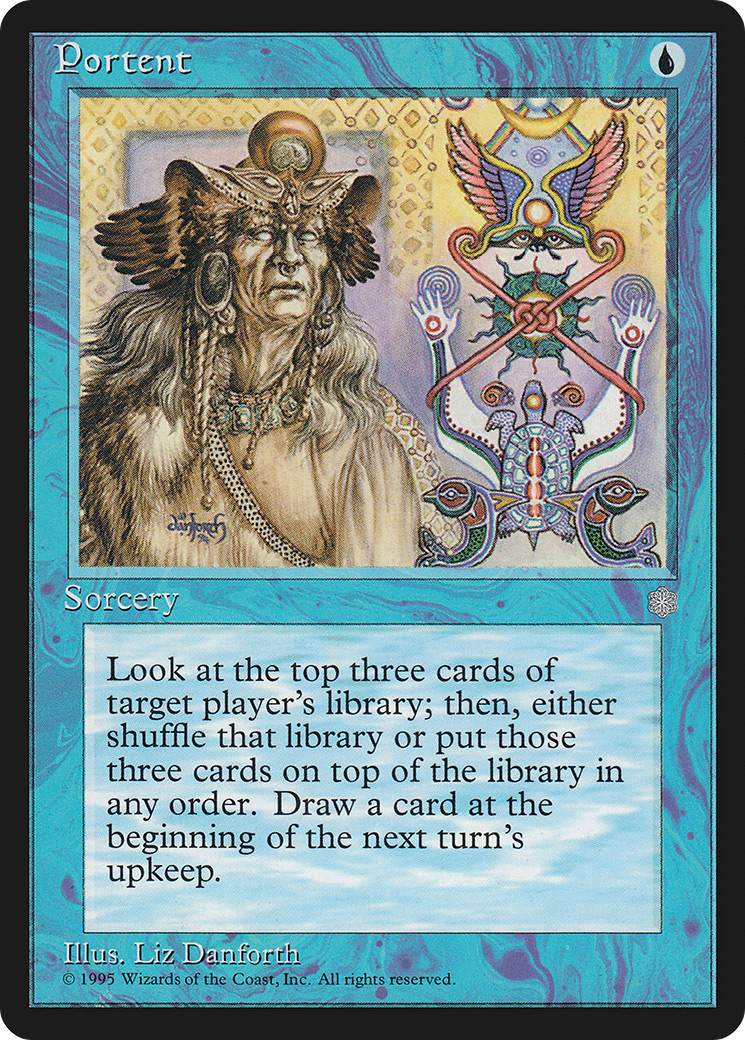
By targeting the opponent, you gain the information of three {Mishra's Bauble}s and can rearrange the opponent's future. Of course, everything currently in their hand will need to be contended with, but if their future is significantly weakened or effectively dealt with ahead of time, you can better map how to align your answers with their threats. Information asymmetry remains powerful yet underexplored outside of {Thoughtseize} strategies.
If the top three cards of their deck pose threats you cannot deal with in time, you can make the opponent shuffle into randomness.
Strengths & Weaknesses
{Porent}, of course, is now without flaws. The delayed cantrip has the upside of triggering a {Terminus} or passing the turn to go up to eight cards in hand, but the downside of being ravaged by {Orcish Bowmaster} or of being unable to develop a much-needed land drop the turn it's cast.
The value of {Portent}ing the opponent is a massive variable. Sometimes, it's contextually equivalent to multiple {Timewalk}s. Other times, it's delayed {Ponder}. {Portent}'s variance makes it an easy cut when trimming a decklist to 60 cards, especially when competing against {Ponder} or {Mishra's Bauble}, which can affect Delirium, Flurry, and recursion effects.
Mortent
I'm looking for as many ways as possible to get more {Portent} in [u][w] decks right now, but in a way they never have before. I've played more {Portent} than most, but rarely targeted the opponent early or proactively. Typically, "{Portent} target you" was reserved for when the board was already stable to lock the game up.
What if we played {Portent} more like {Thoughtseize} than {Ponder}? Would that change the dynamic of difficult matchups in this metagame? I'm not entirely sure, but I'm going to find out.
Join Our Patreon Subscribe to Our Newsletter Submit Your Article To Eternal Durdles
Subscribe to Eternal Durdles on YouTube! Subscribe to (R)Eternal Durdles on YouTube!
Featured image: {Portent} by Liz Danforth