Winning Bronze With Miracles | Value Vintage NYC Invitational Series
On Sunday, Aug. 6, 2026, I sleeved up [u][w] Miracles for the NYC Invitational Series Value Vintage Open at Hex & Co. Union Sq. in New York City. Relatively new to the format, it was only the second time I played with my trusty {Terminus} and {Entreat the Angels}. I punted my way into 4-1-1 for third place overall and felt like I had the best deck in the room.
NYC Invitational Series Value Vintage
Round One vs. Mono-[b] 8-Rack | Win
Round Two vs. Mono-[u] Mill | Win
Round Three vs. Mono-[g] Cloudpost} | Win
Round Four vs. [u][r] {Arclight Phoenix} | I.D.
Round Five vs. Mono-[r] Heroic | Win
Cut to Top 4
Semifinals vs. Mono-[r] {Hollow One} | Loss
My understanding of how to operate Miracles from most of my lifetime playing the archetype across Legacy, Vintage, Peak Legacy, Modern, and any other opportunity to spin {Sensei's Divining Top} (e.g., Classic Legacy) made me confident in my operations. What I lacked was an understanding of the metagame, despite a helpful breakdown from DerKetzerHausen on the Eternal Durdles Discord.
Join the Eternal Durdles Discord
As a result, my sideboard was mostly inadequate. Here's the list I played:
ForceofPhil's Value Vintage Miracles
DECKLIST_START
Companion
1 {Lurrus of the Dream-Den} [1][wb][wb]
Creatures (4)
4 {Squadron Hawk} [1][w]
Instants (13)
4 {Swords to Plowshares} [w]
1 {Brainstorm} [u]
4 {Disruption Protocol} [u][u]
4 {Brainsurge} [2][u]
Sorceries (12)
4 {Prismatic Ending} [x][w]
2 {Entreat the Angels} [x][x][w][w][w]
2 {Witness the Future} [2][u]
4 {Terminus} [4][w][w]
Artifacts (14)
4 {Brainstone} [1]
4 {Fountainport Bell} [1]
4 {Giant's Boulder} [1]
1 {Soul-Guide Lantern} [1]
1 {Sol Ring} [1]
Lands (17)
4 {Prairie Stream}
4 {Mystic Sanctuary}
7 {Island}
2 {Plains}
Sideboard (14 + Companion)
4 {Ivory Tower} [1]
4 {Metallic Rebuke} [2][u]
3 {Soul-Guide Lantern} [1]
2 {Disenchant} [1][w]
1 {Circle of Protection: Red} [1][w]
DECKLIST_END
I presumed that Burn would be a contender. My typical way to combat that matchup in Legacy is {Counterbalance}. Since those were priced out, I leaned on {Ivory Tower}. What I learned is that although [r] is obviously the best color in Value Vintage, the majority of [r] aggro decks seem to be creature-based.

{Ivory Tower} by Margaret Organ-Kean
Throughout the tournament, I played against [u][r] {Arclight Phoenix}, Mono-[r] {Hollow One}, and Mono-[r] {Monstrous Rage}. The first two are effectively spellslinger decks that convert velocity into free creatures, and the third played closer to Infect than Burn. {Ivory Tower} was a poor choice and one I won't make again.
Mill?! (but also Cloudpost?)
Two of my matchups were against mill strategies with some caveats. The non-caveat is playing against actual Mono-[u] Mill supported by the shell of {Exhibition Tidecaller} and {Harmonized Trio} with the boss monster {Jace, the Perfected Mind}.
Without fetchlands to instant-speed {Mystic Sanctuary} onto the table, it was quite the challenge to convert a Miracle. The caveat of the other mill strategy was that it was Mono-[g] Cloudpost. What I learned is how much richer gameplay can be when a format doesn't have the auto-win buttons that offer no legitimate recourse.

{Jace, the Perfected Mind} by Chase Stone
Typically, when I play against big mana in Legacy, the games are nothing more than counting mana and herp-derping the biggest spell in hand that cast triggers some insurmountable advantage that obsoletes any game there was or would be. My [w] cards had text against Cloudpost in Value Vintage so the biggest threat to me was {Trenchpost}.
Uncounterable milling is, as stated before, really challenging without any fetchlands for {Mystic Sanctuary}. Against both mill strategies, I brought in the secret tech: {Soul-Guide Lantern}. While the graveyards were not zones that mattered for the Mill or Cloudpost players, what did matter was an instant speed way to draw a card to go over the top of a mill effect.
I've played against enough {Grindstone} in Legacy to know stacking instant-draw can Miracle around mill. Navigating games toward {Fountainport Bell}, {Soul-Guide Lantern} and the nine {Brainstorm} effects to critical-time a Miracle was, at least from my point of view, the difference-maker.

{Trenchpost} by Carlos Palma Cruchaga
Furthermore against {Trenchpost}, I prioritized never missing a land drop to achieve the end game of {Lurrus of the Dream-Den} for {Giant's Boulder} to nuke a {Trenchpost} for [8] every turn.
These two matches made me recognize that {Pithing Needle} should be in the board in some numbers.
Graveyard Matters
Three of my matchups cared deeply about their graveyards and I was happy to have access to the full boat of {Soul-Guide Lantern}. My opening match of the day was against 8-Rack, which leans on {The Rack} and {Shrieking Affliction} after a flurry of {Raven's Crime} and {Hymn to Tourach} rip hands apart.
The matchup felt much closer in practice than it probably would have appeared on paper. Ultimately, I don't think there was a particular play pattern that was masterful positioning to get the win here as much as the infrastructure of {Squadron Hawk} and {Brainsurge} being big card advantage spells, as well as {Lurrus of the Dream-Den} being a free card to move further away from the pressure of the eight racks.

{Squadron Hawk} by Martina Pilcerova
For anyone who endeavors to pick up {Miracles} in the future in this format, the way to play around discard decks is to navigate your {Brainstorm} effects to hide your critical spells on top of the library.
Speaking of which, DerKetzerHausen told me ahead of time that {Nephalia Academy} is the way to contend against the discard decks. Considering I played against {Raven's Crime} and {Burning Inquiry} in this tournament, the logic is sound. It also harkens back to old tech I used to play in Legacy Miracles in the before times: {Library of Leng}.
Memory Lane
While it may be hard to believe compared to the current Legacy of snowballs, consistent, ostensible turn two kills, or every blue deck having an {Ancestral Recall} planeswalker that has suspend 3 {Peer Into the Abyss}, there was a time when many of the best decks were grindy attrition battles.
That time included Grixis Control with {Baleful Strix}, {Kolaghan's Command}, and {Hymn to Tourach}. Most Miracles players relied on {Spell Pierce} or {Flusterstorm} to combat {Hymn to Tourach} and have broader crossover against the rest of the field.

{Library of Leng} by Daniel Gelon
Those cards were lackluster against specifically the one-two punch of {Thoughtseize} or {Inquisition of Kozilek} into {Hymn to Tourach}, and only {Spell Pierce} could catch {Liliana of the Veil}. Additionally, since games went long, extra mana lying around often led to dead {Spell Pierce}s and {Flusterstorm}s when one of the strategies at the table was actively pursuing fully hellbent gameplay (read: {Force of Will} was necessary to catch planeswalkers on the stack but never felt great because the two-for-one still aligned with Grixis' gameplan).
While it obviously never caught on, I liked teching {Library of Leng} in the board against {Grixis} because it guaranteed spells could go where {Sensei's Divining Top} and {Counterbalance} wanted them: on top of the library, regardless of the stage of the game.
It's a joy to learn that {Nephalia Academy} gets to legitimately continue {Library of Leng}'s legacy in this the year of our lord 2026.
[w] Removal Stonks
I would have loved to play {Ponder} in my Value Vintage list. I was able to do so in the first Value Vintage event I played in at an SCGCon in 2025, but {Ponder}'s price has since climbed just out of range. I also made the poor decision not to register {Gush} because it was the only card over $2 other than {Lurrus of the Dream-Den}.
I thought I could get a similar function for what {Gush} aims to do with {Mystic Sanctuary} by playing a second {Witness the Future} instead. While {Witness the Future} is the best bad card available that always performs well because of the unique effect it offers the strategy (infinite game theory).

{Prismatic Ending} by John Stanko
All that is to say, I cut {Ponder} before {Swords to Plowshares}. You cannot play this type of deck without {Swords to Plowshares}. Fortunately, it hovers around $1 because Wizards of the Coast (WotC) reprints it 60 times a month, similar to {Sol Ring}.
While {Prismatic Ending} was never great because it's a sorcery and is also bad, I don't think it's reasonable to leave home without the full set in this format. You could make the case for {Path to Exile} if budget allows for it or, more narrowly but possible in this build, {Dispatch} instead of {Prismatic Ending}, but {Giant's Boulder} enabling {Prismatic Ending} to hit three or four drops is enough to push it over the top in my opinion.
I would not have been able to keep pace against the Mono-[r] Heroic deck I narrowly beat if I didn't have the full eight copies of [w] removal spells on turn one.
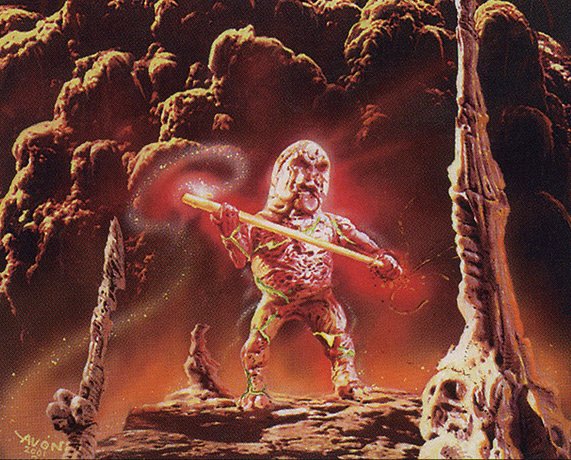
{Anger} by John Avon
Do the Broken Thing
While not broken, the powerful thing Miracles can achieve is even better {Wrath of God} for [w] at instant speed. This is a reminder that if there is a broken thing your deck has access to, you should do that thing.
My only loss in the tournament was to {Hollow One}. Despite my punt in game two where I made an ill-advised attack with {Lurrus of the Dream-Den} that cost me the game, the {Hollow One} player (NYC-legend SWB) killed me on turn two by casting a single {Burning Inquiry}.
Turn one, we both drew three cards and discarded the same amount at random. He Madnessed a {Blazing Rootwalla} and played two {Hollow One}s (flavor fail, it's not Hollow Two, amirite?) and attacked immediately for nine because {Anger} had hit the bin.
On his turn two, he simply pumped the {Blazing Rootwalla} and attacked for 11. Two turns, exactly 20 damage. He had three {Anger}s in his list, and I would have believed and respected if there had been four. {Anger} is {Time Walk} for [0].
So, recognize the broken thing your deck does and maximize that.

{Nephalia Academy} by Adam Paquette
Updated Decklist
While there is certainly an room for refinement, I would play this if there were another Value Vintage event tomorrow:
Companion
1 {Lurrus of the Dream-Den} [1][wb][wb]
Creatures (4)
4 {Squadron Hawk} [1][w]
Instants (13)
4 {Swords to Plowshares} [w]
1 {Brainstorm} [u]
4 {Disruption Protocol} [u][u]
4 {Brainsurge} [2][u]
1 {Gush} [4][u]
Sorceries (11)
4 {Prismatic Ending} [x][w]
2 {Entreat the Angels} [x][x][w][w][w]
1 {Witness the Future} [2][u]
4 {Terminus} [4][w][w]
Artifacts (14)
4 {Brainstone} [1]
4 {Fountainport Bell} [1]
4 {Giant's Boulder} [1]
1 {Soul-Guide Lantern} [1]
1 {Sol Ring} [1]
Lands (17)
4 {Prairie Stream}
3 {Mystic Sanctuary}
7 {Island}
3 {Plains}
Sideboard (14 + Companion)
2 {Nephalia Academy}
3 {Soul-Guide Lantern} [1]
2 {Pithing Needle} [1]
2 {Disenchant} [1][w]
2 {Circle of Protection: Red} [1][w]
3 {Timely Reinforcements} [2][w]
DECKLIST_END
How many {Nephalia Academy} and {Pithing Needle} to include in the board is wobbly without a clear idea of mapping, which would require more reps. I yearned for those effects all tournament, though, so starting with a pair each feels right.
{Timely Reinforcements} felt like the card that I would have loved to have access to as a stabilizing bridge to get out of the early game. Oh, how I long for {Sphinx's Revelation} + {Elixir of Immortality} again.

{Timely Reinforcements} by Tomasz Jedruszek
The Best EV(V)
Value Vintage is sweet AF. I had a blast and played against a different archetype in all six of my rounds (including the I.D. against [u][r] {Arclight Phoenix}, where we still played a game). I can't wait to play more of this format, and praise be unto those who play and support it.
Join Our Patreon Subscribe to Our Newsletter Submit Your Article To Eternal Durdles
Subscribe to Eternal Durdles on YouTube! Subscribe to (R)Eternal Durdles on YouTube!
Featured image: {Fountainport Bell} by Néstor Ossandón Leal