Legacy Locals | Miracles Tournament Report
On July 13, 2026, I played [u][w] Miracles at the Legacy weekly at Gamestoria in Astoria, Queens, NY. Across four rounds, I won some, I lost some, but most importantly, they all taught me how I might improve my ever-evolving Miracles deck. Here's the list I played:
[u][w] Miracles
DECKLIST_START
Instants
4 {Brainstorm} [u]
4 {Swords to Plowshares} [w]
2 {Erode} [w]
4 {Predict} [1][u]
1 {Unexpectedly Absent} [x][w][w]
3 {Brainsurge} [2][u]
1 {Thwart} [2][u][u]
4 {Force of Will} [3][u][u]
Sorceries
4 {Ponder} [u]
2 {Entreat the Angels} [x][x][w][w][w]
2 {Force of Negation} [1][u][u]
1 {Witness the Future} [2][u]
4 {Terminus} [4][w][w]
Enchantments
4 {Counterbalance} [u][u]
Lands
4 {Flooded Strand}
1 {Misty Rainforest}
1 {Scalding Tarn}
1 {Polluted Delta}
4 {Tundra}
4 {Mystic Sanctuary}
3 {Island}
1 {Plains}
1 {Meticulous Archive}
Sideboard
4 {Extract} [u]
3 {Hydroblast} [u]
2 {Force of Negation} [1][u][u]
2 {Erode} [w]
2 {Disenchant} [1][w]
1 {Tsabo's Web} [2]
1 {Surgical Extraction} [bp]
DECKLIST_END
The {Extract} experiment in the sideboard was a way to combat the cards that otherwise don't have a way to reasonably combat them. The targets were removing {Thassa's Oracle} since there is no viable out to {Cavern of Souls}, narrowing the avenues to victory for Storm to win in their maindeck so more fights can happen over {Burning Wish}, a way to strip utility pieces like {Bojuka Bog} and {Boseiju, Who Endures} from Lands' {Crop Rotation} package, etc.

{Brainsurge} by Liiga Smilshkalne
Leaning harder on {Brainsurge} is a nod to {The Fantasticar} making [3]-drops more desirable for {Counterbalance}. The issue with that is {Brainsurge} is soft-banned in an {Orcish Bowmasters} economy, which is Legacy. {Orcish Bowmasters}' stock might be down online since the incentives are to play more combo to speed through leagues. In paper, however, {Orcish Bowmasters} is still prominent. Suffice to say, its a risk for matchup lottery.
Round One vs. [u][w] Phelia | W
This match is extremely grindy, but Miracles is favored game one since [w] cards have text. There were compelling nuance timing considerations for when my opponent should use their {Stifle}s and {Consign to Memory} to fight over Miracle triggers.
Ultimately, the game boils down to whether or not {Phelia, Exuberant Shepherd} sticks on the battlefield. That's pretty much the entire game. {Phelia, Exuberant Shepherd} is among the cards I think of as snowball-engine slop cards, in that they solo games without asking for anything. Other cards in this category include {Up the Beanstalk}, {Tamiyo, Inquisitive Student}, {Kaito, Bane of Nightmares}, {The One Ring}, {Cori-Steel Cutter}, etc.

{Phelia, Exuberant Shepherd} by Rudy Siswanto
With that in mind, I expended as many resources as necessary to keep a {Phelia, Exuberant Shepherd} off the table and eventually a massive {Entreat the Angels} overwhelm any number of {Quantum Riddler}s.
Round Two vs Reanimator | L
My opponent was on the build that splashed [r] for {Faithless Looting} and {Stronghold Gambit} post-board, as well as [u] for {Show and Tell} post-board. The build is so redundant and flush with the same universal effects that I realized I could choose an opening seven-card hand, and it would be insufficient to beat them.
The issue is their deck contains three effects aside from mana: big creatures, reanimation spells, and discard. {Faithless Looting} is the only outlier. Given that only one reanimation effect needs to resolve and the game ends on the spot because of what {Griselbrand} and {Atraxa, Grand Unifier} do, game ones for control seem impossible.
Because of their redundancy post-board becoming even more flush with {Stronghold Gambit} and {Show and Tell}, the match devolves to either find a sufficient hate piece and protect it or lose. These types of combo matchups are unfortunate to pair into as an interactive deck because interaction is insufficient, so you have to become a hatepiece.dek.

{Containment Priest} by John Stanko
In this case, against this version of reanimator, the only viable option is {Containment Priest}. Without them in my board, my maxing out of Force effects was not even in the ballpark of competitive.
It made me consider a card like {Noxious Revival}, which I've tested previously to middling results. Its benefits are functioning defensively to counter a reanimation effect or proactively with {Counterbalance} to free counter whatever they cast.
Typically, there are also moments where it is obvious they are missing a particular piece (i.e., the reanimation effect or the cheat to put a creature into play), and {Noxious Revival} can blank their draw step. I'll explore builds with it in the board again in the future.
Round Three vs. [u][r] Cutter | W
[u][r] Cutter games have three distinct phases where specific cards matter:
One-mana threat plus {Daze}
{Cori-Steel Cutter}
Reloading with {Flow State} to support {Murktide Regent}
Lining up {Counterbalance} in the latter two phases is often strong enough to secure a game if you can get through the first phase, which is pretty much always {Dragon's Rage Channeler}.
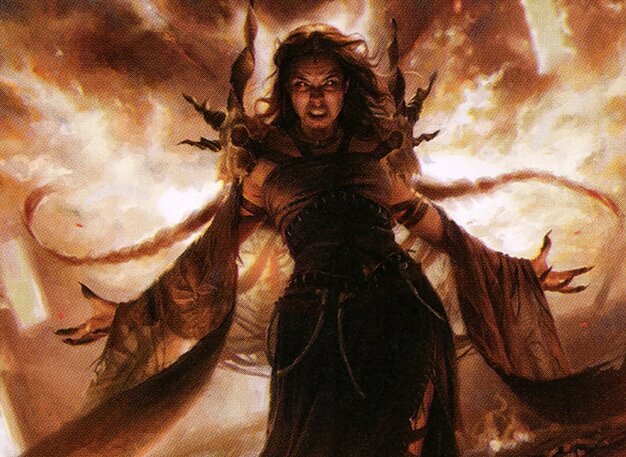
{Dragon's Rage Channeler} by Martina Fačková
{Dragon's Rage Channeler} on turn one, as is the case with {Tamiyo, Inquisitive Student} or {Ragavan, Nimble Pilferer} before it, has to be dealt with before accruing too much advantage for the latter two phases of the game. As a result, the Miracles build has to be redundant enough with removal to trade with the expected {Daze} as well.
Playing around {Daze}, especially on the draw, is not impossible but typically an unaffordable luxury. If your control build has sufficient density of removal, playing into {Daze} is more often correct for two reasons:
If they don't have it, great. Their threat is removed, and they have to decide whether to deploy another one-drop to maintain the first phase or to develop into the second phase.
If they have {Daze}, setting themselves back a turn from entering the second phase can offer a turn of reprieve to cantrip accordingly.
So more often than not, I'm not playing around {Daze} in the first several turns of the game.
{Cori-Steel Cutter} is a snowball slop card. Keep them off the table and expend whatever resources necessary to do so. It's the way design is these days, and without a matching snowball slop engine, you can't beat a snowball slop engine, so keep them off the table as best you can.

{Cori-Steel Cutter} by Xabi Gaztelua
{Counterbalance} has a ton of value in phases two and three of the game. In stage three, {Counterbalance} can't fight over the {Murktide Regent}, but it can fight over the spells that protect it. Typically, stacking a {Force of Will} or a [3]-drop on top of the library for {Force of Negation} before picking a fight over the {Murktide Regent} is the plan. This is why boarding out all your {Force of Will}s is incorrect.
Round Four vs. [u][b] Tempo | L
This matchup is immensely difficult because its entire shell is snowball slop engines sandwiching {Orcish Bowmasters}. Similar to [u][r], there are three phases of the game, albeit less obvious:
{Tamiyo, Inquisitive Student}
{Orcish Bowmasters}
{Kaito, Bane of Nightmares}
{Orcish Bowmasters} is challenging out of non-[u] decks but not impossible to beat since removal is likely to resolve against it. Against Dimir, however, a protected {Orcish Bowmasters} blanks cantrips, which are operationally necessary to align appropriate removal against various threats.
Without the ability to cantrip to align answers to threats, you are at the mercy of having more removal than they have countermagic. If you cantrip for removal, the Orc Army will grow large enough to become a must-answer threat, but the {Orcish Bowmasters} is locking out the ability for control to operate. It's a catch-22 position that requires nothing of the {Orcish Bowmasters} pilot, including never having to expose the {Orcish Bowmasters} to sorcery-speed removal.
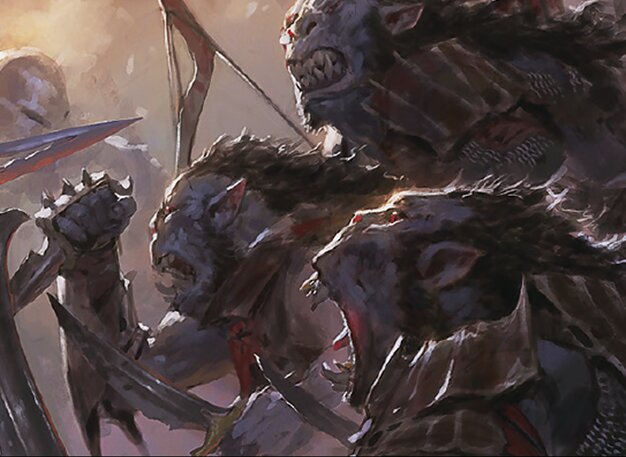
{Orcish Bowmasters} by Tyler Jacobson
Any of Dimir's snowball threats with any protection will solo games by themselves. A reasonable build must have enough answers for these cards specifically. It is why I have included four {Erode} in my 75 since its release.
I played it as a 2-2 main-board split on this night but am likely to return to the playset of {Erode} in the main since {Tamiyo, Inquisitive Student} is ubiquitous enough in the format and {Kaito, Bane of Nightmares} doesn't have reasonable answers otherwise. {Erode} can function as redundant {Swords to Plowshares} when fighting over {Orcish Bowmasters}. It's not the hero we deserve, but it's the hero we have for now.
Til next time, keep believing!
Submit Your Article To Eternal Durdles
Subscribe to Eternal Durdles on YouTube!
Subscribe to Common Sense: Sorcery podcast on YouTube!
Featured image: {Terminus} by James Paick