Extracting Broken Decks With an Underexplored Sideboard Card
Note: The following article assumes a condescending tone toward the stock best decks. This is by design to frame the best decks as heel champions that a babyface underdog can hopefully defeat. Assume the point of view of the babyface underdog rather than the heel champion or a cynical third party.

{Turtle-Duck} by Sylvain Sarrailh
Lame-duck formats like current Legacy are double-edged. {The Fantasticar} will almost certainly catch a ban on Aug. 10, 2026 — the date of the next banned and restricted announcement. Until then, the best decks are those that adopt {The Fantasticar}. Everything else is designed to ignore it, or is so overloaded to beat it that it concedes a significant percentage of its matchup spread.
I, however, am a stubborn believer who still looks to the heavens for the most viable, theory-proofed version of Miracles available. Years of losing most games in this pursuit have offered a unique intuition for identifying an oft-overlooked aspect of the game: format patterns.
History Repeats Itself
Current Legacy feels extremely similar to another lame-duck Legacy format: when [u][b] Tempo splashed the broken 10-card Reanimator package of four {Entomb}, four {Reanimate}, one {Atraxa, Grand Unifier}, and one {Archon of Cruelty}. That 10-card package was an S-tier strategy on its own and only required another 50 cards to be legal.
The best shell, [u][b] Tempo comprising a stock of approximately 46 cards — {Force of Will}, {Daze}, {Brainstorm}, {Ponder}, {Thoughtseize}, {Tamiyo, Inquisitive Student}, {Orcish Bowmaster}, {Wasteland}, manabase — made it an easy build to solve. Other {Underground Sea} decks acted similarly. Entombsday players reminisce.
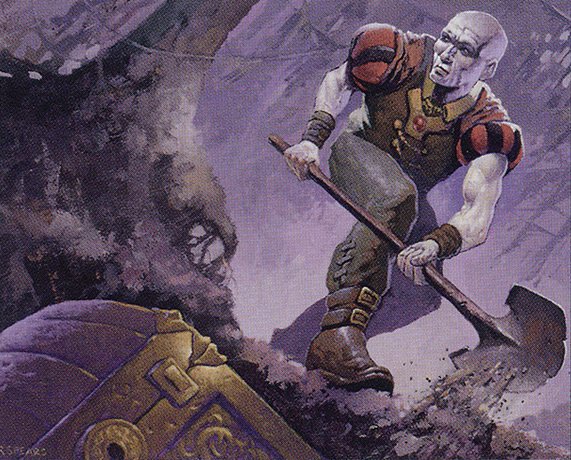
{Entomb} by Ron Spears
"Legacy Is a Turn One Format"
During that era, every match assumed the inherent threat of potentially ending effectively on turn two. A turn two {Atraxa, Grand Unifier} on the play with multiple free counterspells before and/or after it's on the battlefield isn't deterministic, but most games were ostensibly over. Turn hands face-up, line up the mulligan simulator, cool format.
{The Fantasticar} and its best shells are extremely similar. Sixteen haste power in the air isn't deterministic, but most games that open a {The Fantasticar} sequence are over before they start. Turn hands face-up, line up the mulligan simulator, cool format.
While there are tools across colors to combat {The Fantasticar} if they're luckily found in an opening hand, {The Fantasticar} is a decoy for whatever the shell it's in is actually designed to do. Similar to the {Entomb} package of yesterformat, {The Fantasticar} is an S-tier strategy all its own when paired with {Dark Ritual} or {Ancient Tomb} and [0] mana artifacts the best decks already play.
{Dark Ritual} by Sandra Everingham
The ever-broken [u][b] Tempo shell that formerly adopted the {Entomb} package just picked up a set of {Dark Ritual}, {Lotus Petal}, {Mishra's Bauble}, and {The Fantasticar} to run back the same experience of the "Legacy is a turn one format" meme entrenched players have historically had to defend against.
The Miracle in Disguise
The benefit of an obviously broken format is how clear the target becomes. In these trying times, my secret weapon, my go-to Pablo Sanchez, if you will, is {Extract}.

When the best decks are that way because of a broken card/package, the goal is to reliably beat it, assuming the tools are available, without diluting your deck so much that it can't contend with what the rest of the best decks do without the broken package.
Don't get me wrong: doing the best thing is always a stronger strategy than trying to stop the best thing, because the former is the proactive, game-winning strategy in the dark. The latter hinges on facing the former and still includes the inherent fail rate of the broken thing doing what it does.
The reward for playing the broken thing is winning the game. The reward for stopping the broken thing is pride.

{Kjeldoran Pride} by Kaja Foglio
In the old Reanimator case, that meant solving the {Entomb} plus {Reanimate} puzzle reliably and then having a deck that could otherwise contend with stock Modern Horizons [u][b] Tempo.
By the end of that format, I sought to face the match-up because {Extract} solved the first puzzle, and the rest of the shell was beatable with a shitpile of [w] cards since their cut to make room for the broken package was {Kaito, Bane of Nightmares}.
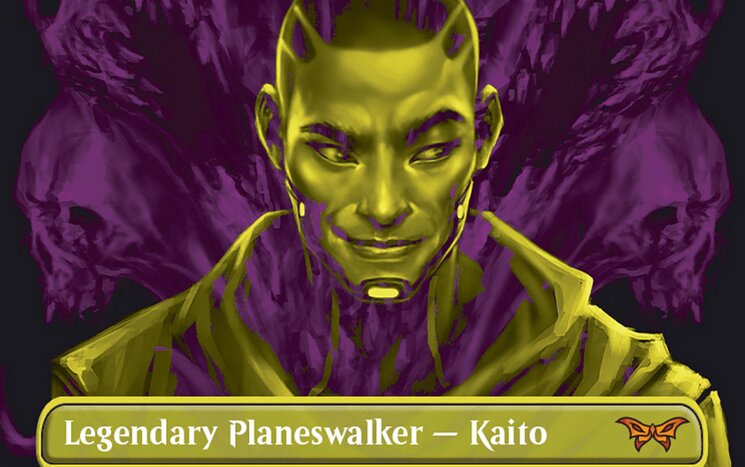
{Kaito, Bane of Nightmares} by Richard Luong
At the time, {Tundra} couldn't beat {Kaito, Bane of Nightmares}, since it was the Initiative deck rolled up into one card; it functioned like {Cavern of Souls} into a snowball threat that couldn't be interacted with.
At the time, however, the broken decks had to adhere to the constraints they imposed on the format. An uncounterable, snowball draw engine that locks down the opposing board and closes the game by itself for [1][u][b] means nothing if games were expected to end on turn two.
{Extract} was a proactive way to cut off the singleton {Atraxa, Grand Unifier} from the Tempo Reanimator deck. Everything else was contending against the best deck without its unbeatable threat against you.
{Extract} has similar implications in {The Fantasticar} format, but in reverse. Rather than solving the broken, soon-to-be-banned package that is {The Fantasticar}, it can solve the {Cavern of Souls} problem.
{Cavern of Souls}
{Cavern of Souls} is arguably the worst-designed card in the history of Magic: The Gathering. Other historically bad designs might include something broken on power level, an operational mistake, or an overwhelming effect. Think of the {Underworld Breach}s, {The One Ring}s, and Initiative mechanics of the world.
Those mistakes, like {The Fantasticar}, are obvious on their face. Of course they're broken; they require simply imagining the first playtest game to bust them. Just massive, avoidable blunders at face value. They aren't interesting.

{Cavern of Souls} by Cliff Childs
{Cavern of Souls} is different. It doesn't create the flashy fireworks of {Underworld Breach} or have the weight of an external intellectual property influencing the design team to make it a staple in an alternative four-player casual format.
{Cavern of Souls} blanks all forms of interaction for free without any window to respond, removing all potential counterplay entirely. Similar cards that came before it, like {Boseiju, Who Shelters All}, entered tapped, allowing for a turn cycle of counterplay via {Wasteland}, {Back to Basics}, and the like, before it provided the means to end the game without recourse. Even the analogous {Mistrise Village}, which can enter untapped, is mana-gated.
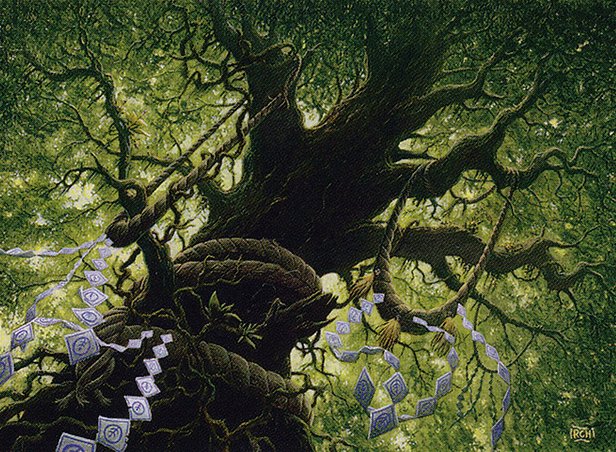
{Boseiju, Who Shelters All} by Ralph Horsley
When {Cavern of Souls} is the lane by which a single spell like {Thassa's Oracle} in {Doomsday} ends the game, even an onboard, zero-mana, instant-speed effect like {Wasteland} is too slow. Among the 30,000+ cards available in Magic: The Gathering, none interact with {Cavern of Souls} if it is not already on the battlefield (e.g., {Alpine Moon}, {Blood Moon}, {Harbinger of the Seas}, etc.).
As a result of {Cavern of Souls} dictating the rules of engagement, people adopt tools like {Consign to Memory}, {Stifle}, {Dress Down}, or {Endurance} to combat {Thassa's Oracle}. That often proves insufficient against {Doomsday} because they can sculpt a pile that can beat any of the cards that are waiting for {Thassa's Oracle} to appear.
{Cavern of Souls}'s existence simplifies the paths {Doomsday} needs to navigate by such a degree that its only bottleneck from being the best deck was consistently finding its namesake card. {The Fantasticar} doesn't directly solve that problem, but it does offer {Doomsday}'s fast mana plus cheap disruption shell a payoff at the same mana cost, without any deckbuilding concessions.
Enter {Extract}
{Doomsday} is a one-card combo deck, better at resolving its namesake than any non-degenerate is at stopping it. Your win condition isn't whatever you sleeved up. Rather, it's defeating the pile they will inevitably sculpt.
{Thassa's Oracle} by Jesper Ejsing
{Cavern of Souls} in their pile means stack interaction against {Thassa's Oracle} is irrelevant. That allows the rest of the pile to comprise cards that can beat the aforementioned cards aimed at stopping {Thassa's Oracle}'s trigger.
{Extract} can strip the {Thassa's Oracle} from their deck before or after {Doomsday} resolves. Without {Thassa's Oracle}, {Cavern of Souls} is no longer the dictatorial force deciding outcomes for free. It can't protect a {Jace, Wielder of Mysteries} on the stack, and {Doctor Doom, Unrivaled} has summoning sickness.
It's not the hero we want, nor the hero we yearn for. It's, unfortunately, the hero we need.
Extracting the Format
Here's my current Miracles list for the next month:
DECKLIST_START
Instants (25)
4 {Brainstorm} [u]
4 {Swords to Plowshares} [w]
2 {Erode} [w]
4 {Predict} [1][u]
1 {Unexpectedly Absent} [x][w][w]
3 {Brainsurge} [2][u]
2 {Force of Negation} [1][u][u]
1 {Thwart} [2][u][u]
4 {Force of Will} [3][u][u]
Sorceries (11)
4 {Ponder} [u]
2 {Entreat the Angels} [x][x][x][w][w]
1 {Witness the Future} [2][u]
4 {Terminus} [4][w][w]
Enchantments (4)
4 {Counterbalance} [u][u]
Lands (20)
4 {Flooded Strand}
4 {Tundra}
4 {Mystic Sanctuary}
3 {Island}
1 {Meticulous Archive}
1 {Misty Rainforest}
1 {Plains}
1 {Polluted Delta}
1 {Scalding Tarn}
Sideboard
4 {Extract} [u]
3 {Hydroblast} [u]
2 {Disenchant} [1][w]
2 {Erode} [w]
2 {Force of Negation} [1][u][u]
1 {Surgical Extraction} [bp]
1 {Tsabo's Web} [2]
DECKLIST_END
I don't expect {Extract} to be in my sideboard after August 10. I do, however, expect it to find its way back to combat the next inevitable broken format Wizards of the Coast will befall Legacy with.
In times like these, I think of the great poetic laureates whose words summarize the trying times we endure:
"Rules were meant to be broken, but you can't make broken rules."
—Ludacris
Submit Your Article To Eternal Durdles
Subscribe to Eternal Durdles on YouTube!
Subscribe to Common Sense: Sorcery podcast on YouTube!
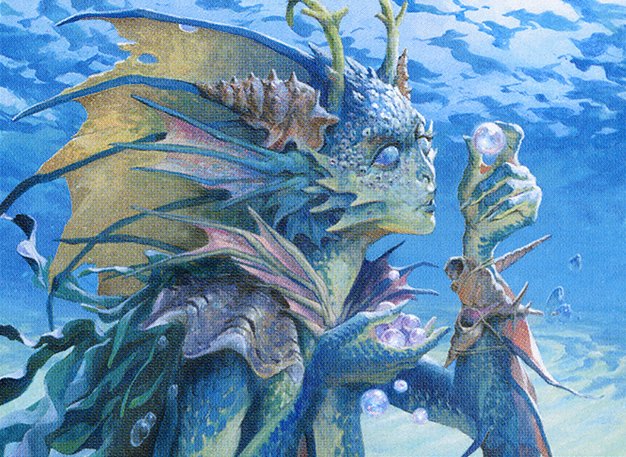
Featured image: {Extract} by Matt Cavotta