



Months ago, the Legacy format saw two high-profile bans: Candelabra of Tawnos and The Fantasticar. The former is quite old, and the latter is very new; printed 32 years apart. I’m interested in assessing these ban choices, what they reveal about Wizards of the Coast's (WotC) competitive format design philosophy, and how they are shaping the game.

The Fantasticar by Maxim Ruabtsev
The Fantasticar ban was widely anticipated for the official banned and restricted (B&R) announcement on June 29, 2026, because it had a runaway win rate in Legacy and Vintage upon release. Instead, the ban that day fell on Candelabra of Tawnos, which appeared in the same ‘big mana’ colorless decks.
While banning Candelabra of Tawnos on June 29 was surprising, the conspicuous lack of a ban on The Fantasticar until August 10 overshadowed it. Thus, the ban of Candelabra of Tawnos has been widely interpreted as hasty scapegoating. For such a novel pair of bans, I think the decision invites more deliberation.

Candelabra of Tawnos by Douglas Shuler
Most conversations around the ban of Candelabra of Tawnos invariably brought up Entomb and Planar Nexus. Among many commenters, the popular sentiment has been that Entomb simply needed to go; its ban was long overdue, and it was always a problem card despite other cards being banned around it.

Entomb by Ron Spears
By contrast, Candelabra of Tawnos provoked the opposite reaction, with fingers pointed at The Fantasticar and Planar Nexus as the real problem cards in colorless big-mana decks. First, I doubt banning Planar Nexus alone would have appeased the demand to ban The Fantasticar in most people's minds. It’s also worth questioning why Candelabra of Tawnos would be banned before Planar Nexus, given The Fantasticar would eventually be banned as well.

Planar Nexus by Sam Burley
Criticism that The Fantasticar should have been banned instead of Candelabra of Tawnos was widely and confidently stated until the car was hit. By comparison, suggestions to ban Planar Nexus read more like wishful thinking to salvage Candelabra of Tawnos. I gather players don’t have much sustained conviction to actually ban Planar Nexus.
The ban on Candelabra of Tawnos less than a year after banning Entomb implies both cards have been long overdue, from WotC's perspective. So, when do format mainstays overstay their welcome? To help answer that, consider one key similarity between Candelabra of Tawnos and Entomb: when they were banned, each card was clearly the best at what it did.
This ‘best in slot’ status, to borrow a term from World of Warcraft raid culture, usually means a clearly best-performing option in a competitive setting. Whether a player’s card or a character’s armor, that option is not merely popular to include and build around; it's also the most viable option for its ‘slot’. Typically, players judge these on narrower performance metrics like resource value and damage output.

Unmask by rk post
Grief usurping Unmask’s deck slot in classic Legacy Reanimator decks would be a good example of a card becoming ‘best in slot’. They work similarly, but you can squeeze out extra value from Grief as a reanimation target if needed. Once attained, the piece counts toward completion of a build until the game devs introduce competition.
World of Warcraft and other MMOs have historically dealt with this by leaning into power creep or ‘vertical progression’, which carries a host of problems that even patching may not solve. Physical card games, by contrast, tend to be less capable of, or more averse to, such solutions, opting instead for more ‘horizontal progression’.
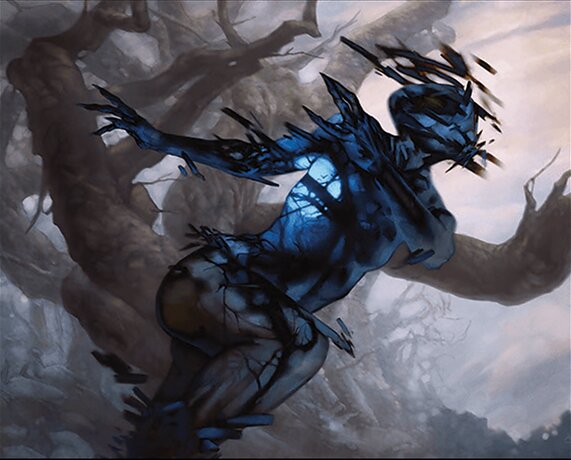
Grief by Nicholas Gregory
When competitively dominant cards create stagnant game environments where solutions narrow to pushing numbers up with new releases, that encourages a ban. Entomb became an obvious ban target once its efficiency was proven beyond its longtime home archetype, Reanimator.
The oppressive ‘Scam’ archetype of the time incorporated Entomb into a Reanimator package. Entomb’s reputation shifted from the best card in a relatively clunky Reanimator strategy to one of the best cards in Scam’s Reanimator variant.
Entomb’s inclusion further showed that a Reanimator package was more splashable than previously thought. This was largely because Grief and Troll of Khazad-dûm provided midrange viability, whereas Reanimator was conventionally a combo deck that relied on sticking a narrow range of large threats. Grief and Troll of Khazad-dûm each provided a respectable threat in a pinch, improving win rates, and both went on to get banned in turn before Entomb.
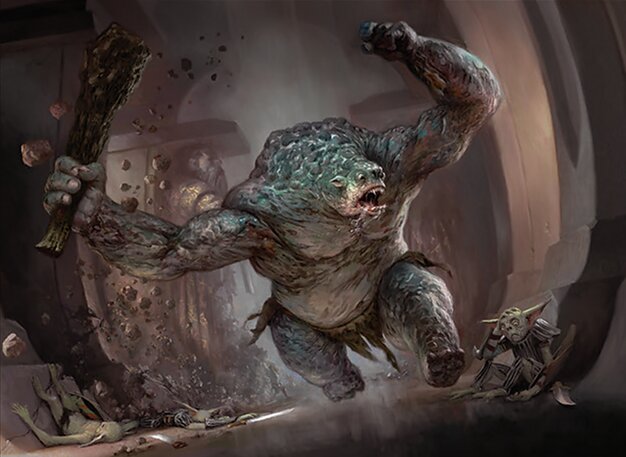
Troll of Khazad-dûm by Simon Dominic
The June 29, 2026 ban announcement suggests a similar path for Candelabra of Tawnos. Having an early home in High Tide variants, Candelabra of Tawnos found its way into a colorless Tron deck by the time of the article.
The article glosses over Candelabra of Tawnos showing up in 12-post decks a couple of years earlier, which bears many resemblances to the colorless Tron deck the ban announcement features. It shares the same inclination toward the opening incantation of “Ancient Tomb, Candelabra of Tawnos, Chalice of the Void for X=1” and the inevitability of a hardcast Emrakul, the Aeons Torn.

Sorcerous Spyglass by Kieran Yanner
It just lacked stronger interaction pieces like Disruptor Flute (settling for Sorcerous Spyglass) and Kozilek’s Command, which I doubt WotC or most competitive players would want to ban instead. Competitive players value interaction for slowing games down and increasing decision-making. Yet, steady improvements to interaction cards would increase the viability of colorless big-mana decks, just as it did for combo decks gaining midrange options.
While not as stark a progression, Disruptor Flute after Sorcerous Spyglass is a little like Grief after Unmask. Having flash can be a comparable boost in a design’s utility to an effect showing up in a different card type — depending on the strategy.

Disruptor Flute by Xavier Ribeiro
It’s fairly difficult to criticize Disruptor Flute in isolation the way you can Grief, but that may point to a subtler problem. Even softer upgrades or sidegrades can contribute to power creep over time—and that’s not necessarily bad.
I appreciate that WotC downshifted Sorcerous Spyglass to uncommon rarity in the Foundations set after debuting it as rare in Ixalan. It feels like WotC R&D is acknowledging a re-assessment of the status quo. That’s something I’d like to see more often. Sometimes a little power creep is necessary for a design iteration to reach where it might ought to have been in the first place — in which case what we call power creep may be a case of vertical progression.
WotC pushes too far at times, but do we really want to go back to the status quo of balance in the 90s? For those who mainly like locked formats, perhaps even most locked-format admirers, returning to mainstream formats again might be appealing. A little more can be better than nothing, and that can add up over time.
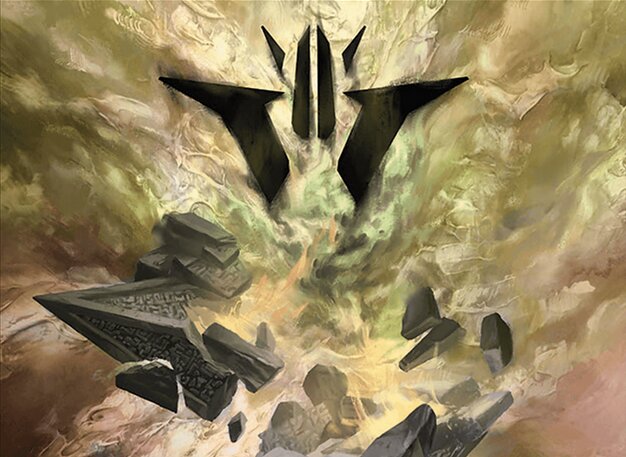
Kozilek's Command by Yeong-Hao Han
Disruptor Flute, along with Kozilek’s Command, provides big mana colorless lists with fairly strong interaction pieces that were previously unavailable, much like Grief and Troll of Khazad-dûm being reliable midrange pieces in Reanimator. Just as creature threats can contribute to power creep in Magic: The Gathering, so can the answer cards competitive players demand.
Part of what makes Disruptor Flute better than Sorcerous Spyglass isn't simply that it has flash in isolation, but that Kozilek’s Command is also instant, and holding both gives the player a little extra choice in gameplay. Certainly, lists running Candelabra of Tawnos would consider whatever interaction packages are available.
Once there are an increasing number of cards which push into a particular design space, whether it’s interactive spells in colorless or Reanimator-friendly midrange options, WotC may have to ask themselves, “Should we ban a card in an oppressive archetype because it contributes to the win rate, if we expect to print more cards in a similar design space?”
Saying yes and ‘ban around’ the problem card may just kick the can down the road. To say no likely means more to come -perhaps tamer alternatives which may help to justify a ban. Going by the tone of the Entomb ban announcement, it’s not necessarily an easy decision to make.

Final Frontier by Jessica Rossier
The rise in colorless interaction came before (The Fantasticar) launched. Plus, Grim Monolith offered a better scapegoat ban option for The Fantasticar, and it follows similar early-game play patterns to Candelabra of Tawnos.
Grim Monolith even cleanly functions as a sort of colorless Pyretic Ritual for exactly the mana The Fantasticar needs. The difference is that, unlike Candelabra of Tawnos, Grim Monolith doesn’t also sometimes just fuel an explosive early hardcast Emrakul without something like Power Artifact. Candelabra of Tawnos only requires a lucky draw of lands in the right order, and you can hardcast Emrakul as early as turn three (e.g., Cloudpost, Vesuva + Candelabra of Tawnos, Cloudpost).
The picture starts to look less like The Fantasticar being the principal cause for Candelabra of Tawnos' ban and more like the straw that broke the camel’s back. Put another way, the candle was burning at both ends, with colorless gaining better threats and better answers.

Grim Monolith by Chippy
Planar Nexus, at least in principle, is still poised to enable more diverse strategies down the line. WotC R&D has been doing more with land types in recent years, both basic and nonbasic. Future sets may bring stronger Caves, Deserts, Gates, Towns, and now Planets for Planar Nexus to support.
Those nonbasic land types aren’t necessarily defined by big mana effects the way Locus and Urza’s lands are, so while both Planar Nexus and Candelabra of Tawnos enable problematic big mana strategies, Candelabra of Tawnos does so more narrowly and more explosively — it doesn’t really do much else. Even Entomb was a cute inclusion in some Life From the Loam lists that prioritized synergy over explosive impact. In hindsight, banning around Entomb was delaying the inevitable, so it seems WotC decided the writing was on the wall for Candelabra of Tawnos.

Urza's Tower by Mark Poole
The favoritism toward Planar Nexus is easier to understand when we appreciate its design history. Though a newer card, it is part of a long-running design experiment. Among the various design stories WotC R&D tells is Barry’s Land. It appeared in the Mystery Booster gimmick set, which referenced design-team in-jokes and shelved concepts.
Barry’s Land was a recurring design goal, named after Barry Reich, the creator of the domain mechanic. The goal is to have a land card that is able to increase a player’s basic land or ‘domain’ count. Barry’s land is a recurring design challenge, and has influenced numerous innovations and standout single-card designs. Wastes from Oath of the Gatewatch came from a similar design exploration, although the rules apparently couldn't justify an associated basic land type.

Reliquary Tower, first printed with Knight of the Reliquary in Conflux, was initially meant to be an earlier Barry’s Land-type design. Something to the effect of ‘your domain count is +1,’ but R&D couldn’t get that to work cleanly in the game rules.
The first reprint of Reliquary Tower was in M13, where it received updated flavor text as a nod to the initial intention that it might work with Knight of the Reliquary in a domain strategy. WotC has shown they can be more practical and reserved, but they’re also willing to try and try again to pursue a design vision they believe is fruitful. Personally, I appreciate their design space exploration.
Land diversity, especially nonbasic, is a theme WotC clearly enjoys returning to. Seen as recently as Star Trek, the current set release at the time of writing, we’re sure to see more of it in the future. As Field of the Dead has shown in the past, this design space can still produce banworthy cards. Sometimes the ban falls on cards that are older than we expect. The motivation for keeping Planar Nexus off the ban list is clear, but we can also be more critical of Candelabra of Tawnos.

Field of the Dead by Kev Walker
Banned alongside Candelabra of Tawnos on June 29 was Seeker of Skybreak in Pauper for its role in a One-Turn Kill (OTK) with Hawkeye’s Bow. It can be tempting to pin the blame on Universes Beyond for breaking older cards. I expected Hawkeye’s Bow to get the ban, but I was curious to see what WotC would actually do.
Yes, on some level there does seem to be preferential treatment toward newer products delaying bans — Grief, Fury, and Karn, the Great Creator come to mind. But over the years I’ve come to expect WotC to be stubborn about banning old favorites too, along with tolerance for oversights and dated design throughout Magic’s history. Think Cephalid Illusionist, which became part of the Legacy format’s wallpaper.

Cephalid Illusionist by Pete Venters
As important as it is to criticize lax design principles in new cards, old oversights shouldn’t necessarily be coddled either. A format name like Legacy actually works against competitive balance here. It’s defensibly in-flavor to embrace design mistakes, whether out of nostalgic familiarity or infamy. Is that what players want from the format? And what does WotC seem to want? That can be difficult to discern, but both things can be true.
Universes Beyond features some questionable pushes, and some old cards see modern design sensibilities catch them. It could help to split Legacy into a format full of broken yet nostalgic mistakes and a more curated, competitively minded format. Modern could take up the mantle, but that depends on player perception of Modern Horizons' experimental nature. The name Modern, again, works against the format here; it doesn’t necessarily adhere to modern design balance, nor is it a rotating format that deals in new cards like Standard, whatever ‘standard’ even means.

Karn, the Great Creator by Wisnu Tan
Pauper, meanwhile, is one of the more conceptually coherent formats around. To begin with, the common-rarity restriction implies some built-in balancing for what efficacy we might expect. This leans more toward balance correction, where Modern, Legacy, or Vintage might be compromised by cards deemed more central to a format’s identity. Thus, announcing a comparable ban for Pauper alongside Legacy emphasizes the deliberateness of the decision.
The choice to ban Seeker of Skybreak instead of Hawkeye’s Bow was a similar upset to Candelabra of Tawnos' surprise ban instead of The Fantasticar, suggesting some intentionality in these ban choices.

Seeker of Skybreak by Daren Bader
One issue in common between Candelabra of Tawnos and Seeker of Skybreak is their ability to generate explosive resources to fuel OTKs, or produce game states that lead to virtually the same result. The Fantasticar may not have won the same turn it dropped, but it reliably got you most of the way there with four 4/4s in the first couple of turns.
Candelabra of Tawnos may not have produced infinite mana on its own, but the explosive resource lead could virtually have a similar impact.
Hawkeye’s Bow was a development miss. Infinite tap/untap combos are a known quantity, and tying an unlimited 'whenever' clause to tapping is playing with fire. However, I also doubt R&D staff intentionally made Seeker of Skybreak able to untap itself infinitely.

Hawkeye's Bow by Marc Aspinall
It can read like a very innocuous ability at first, and I suspect several players wouldn't catch the loop until someone explains that the word ‘another’ is absent. Even those who read the card correctly the first time are liable to assume it's some pre-errata text and want to verify the Seeker’s ability to untap itself.
”Well, of course it doesn’t work that way. Right?” Of course old cards don’t work in silly ways, except when they do. And that sort of bother is another, subtler issue common to Candelabra and Seeker of Skybreak: gameplay legibility.


I invite readers to glance over the two old artifact cards above — I’ve chosen these in part for their relatively good legibility for their time of printing.
Suppose a game runs long, you have 10 basic lands out with this pair of artifacts, and you have two cards in hand. How many activations can you get out of your artifacts? Players in locked formats might be familiar with the quirks of old cards, but those quirks still present hurdles for newer players and can hurt player retention.
Not everyone interested in playing with retro cards has been with the game since Alpha; some younger players may trickle in with cards inherited through an old shoebox discovered in a closet. Others might be charmed by the older card art or be fond of retro frames from sets like Time Spiral Remastered or The Brothers War bonus sheet.
Very few artifacts in the game have an original printing with ‘Mono’ or ‘Poly’ artifact in the type line. Fewer are on the reserved list, and even fewer are among those we’d expect to see enough play to become familiar. For instance, it's easy to miss that Flying Carpet can only be activated once per turn.


This is much better. Here we can distinguish that Flying Carpet has a tapping cost. I tend to like having more recent printings of cards. I tend to like when a printing of a card more closely reflects its updated official, or ‘oracle’ text. This makes the cards easier for other players to read and produces more sporting gameplay. It’s friendlier to newer players and saves time on judge calls that require consulting oracle text in competitive play. Reprinting is a highly valuable technology for a card game, usually taken for granted. But what happens if you don’t get to have reprints?
Reserved List cards in Magic are disallowed from being reprinted. Generally, complaints about the Reserved List focus on accessibility and cost, but for gameplay relevance, there are also visibility and legibility issues. When cards are rarer, players see them less often at tournament tables. This means players have less exposure and are less likely to understand how they function.

The Reserved List really does get in the way of legibility. Take, for example, once more, our Flying Carpet and put it next to Sandals of Abdallah. They both grant an evasion effect, cost the same to activate, and have the same mana value. They’re both old mono artifacts in their printings, from the same set, and both feature the same conditional destruction drawback templating.
Except they don’t, and it’s not simply because Flying Carpet has an updated oracle text. Sandals of Abdallah’s oracle text notably, or rather unnotably (for lack of any reprint), actually keeps the drawback. As locked formats like Premodern and Classic Legacy grow in popularity, and players put value in collecting original printings to play with, this becomes a more relevant problem.

Thran Tome by Donato Giancola
Sad as it may be, even triple-sleeving and casing graded cards may not be enough to keep Reserved List cards from succumbing to entropy. Diary of Dreams in Secrets of Strixhaven added new information to Thran Tome by introducing the Book typing for artifacts, which may matter in competitive play.
While the art in this example conforms to this additional characteristic, such consistency in Magic: The Gathering isn't always guaranteed. Neither Phyrexian Tower nor Reliquary Tower are Towers; Urza’s Tower is. In fact, it’s curiously the only Tower in Magic at this time — unless you count Planar Nexus. If and when that changes, it’d be nice to have reprints, along with updated official text.

Diary of Dreams by Genel Jumalon
Such informational updates could inform future bans in the interest of gameplay legibility, since reading is an essential component of a card game like Magic: The Gathering. More legible cards can reduce the knowledge burden that bars entry to eternal formats. While some players will pride themselves on knowing obscure information, a lack of approachability can discourage both new and veteran players from continuing the game. How much Magic literacy should a card demand of a player?
The information shown — and not shown — by cards can be critically important for legibility. Two examples that demonstrate the value of visual information for higher legibility are Dryad Arbor from From the Vault: Realms and Cryptic Command from Amonkhet Invocations.
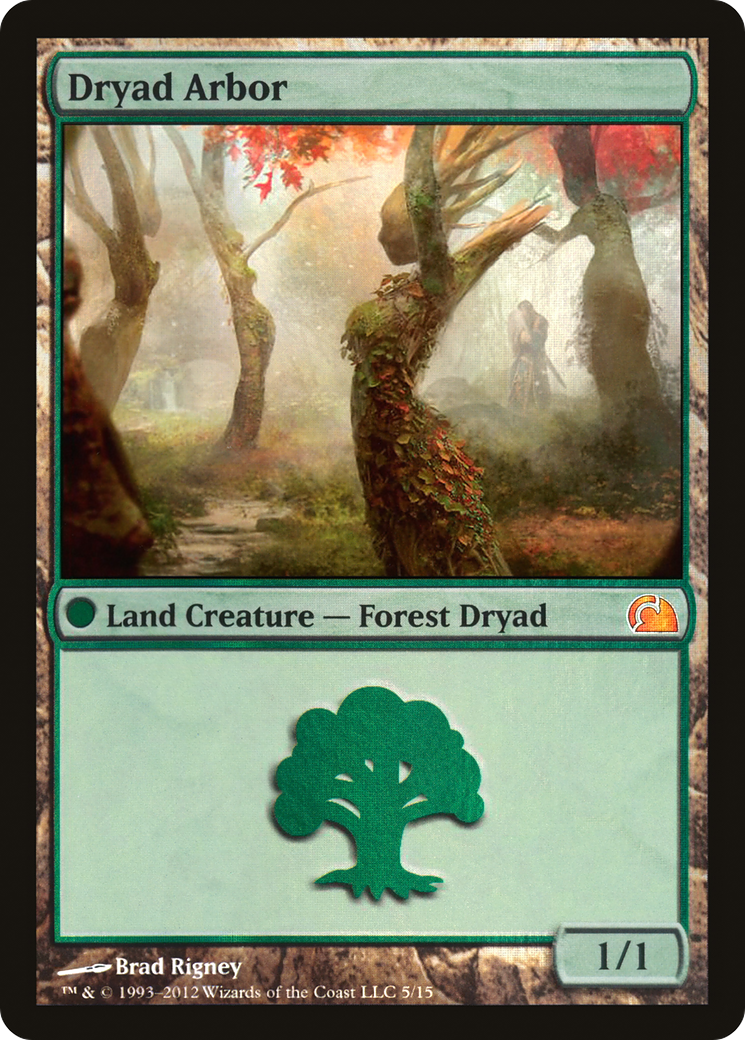
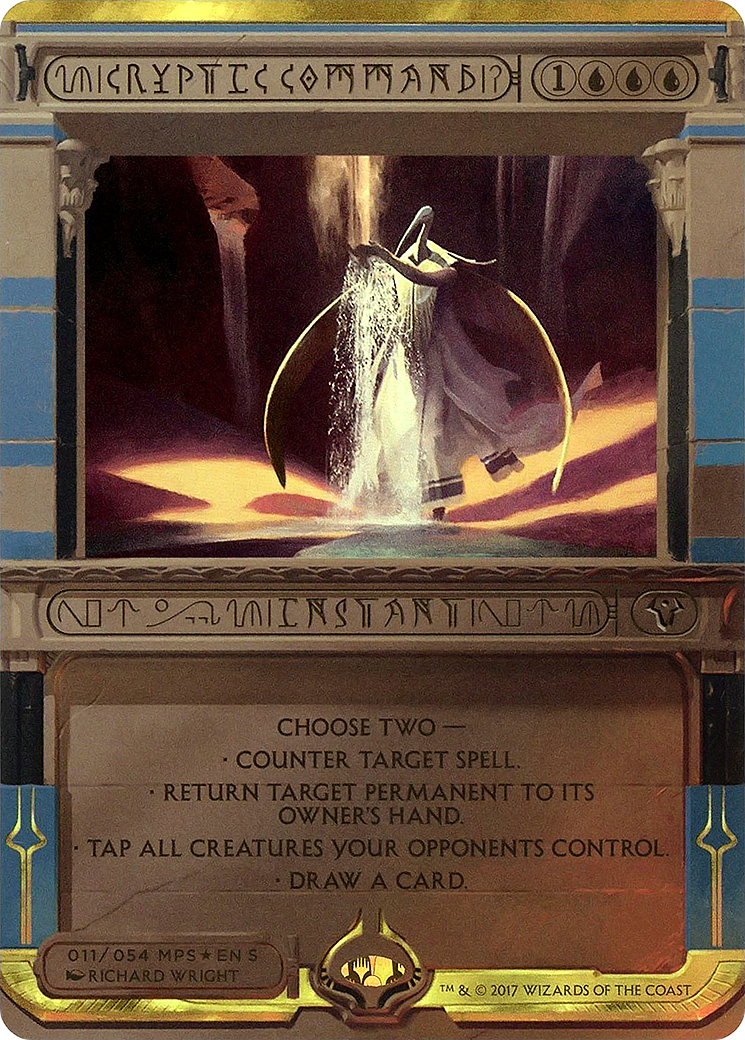
Both printings are visually striking, with unusual appearances. Dryad Arbor uses minimalist templating, while Cryptic Command is more embellished. Both achieve a visual camouflage effect. This visual camouflage creates more moments in gameplay where an opponent pauses to ask, “What’s that?”
Yet, both printings actually represent their oracle text more accurately than Candelabara of Tawnos. It’s possible WotC in the future may officially implement ‘bounce’ as a game term the way they’ve done for mill, and that will date the Amonkhet Invocation printing, but the text ‘return… to its owner’s hand’ would still describe the game function more clearly than ‘mono artifact’ ever will.
Dryad Arbor does draw some criticism for not looking sufficiently like a creature. Cryptic Command and the other Amonkhet Invocation cards draw criticism largely for obscuring the name and type lines. The criticism is essentially the opposition to obscuring game information. Candelabra of Tawnos deserves that criticism. It does not necessarily look like an artifact that taps to activate its ability, and ‘mono artifact’ says nothing without prior knowledge to explain this.
Some players deliberately angle-shoot by tucking Dryad Arbor with lands, which has been officially ruled against. There’s no such rule for indicating whether or not mono artifacts ought to tap. In the case of Dryad Arbor, it can be argued there’s sufficient flavor value in actually having an emergent on-board trick for simply placing a land creature with your lands — hiding in plain sight.
Perhaps the right compromise would be to ensure players don’t bunch their lands, a tough habit to break. But maybe there’s good reason to insist players splay out their lands so opponents can track resources more easily. Regardless, attacking against a planeswalker and discovering a creature emerge from the woodwork can be a nasty surprise. But then again, isn’t a creature camouflaged by minimalist representation of game mechanics a design success? I can’t offer similar praise for Candelabra’s mono-artifact quality of omitting the tap symbol.
And for all the criticism and praise Dryad Arbor may receive, there’s at least the possibility of a reiteration, perhaps a template that more overtly states the creature characteristic. There’s no avenue to officially reprint Candelabra of Tawnos since it’s on the Reserve List. Dryad Arbor and Cryptic Command could have their most problematic printings banned for strict competition, and more easily legible versions would still be available.
Another defense for Dryad Arbor’s camouflage effect is that it’s plainly fun. It’s fun to put a land creature with your lands and maybe even forget it’s a creature, not a basic Forest, because it blends in so well. It’s fun to take a moment to read the title and typeline of Cryptic Command and appreciate how the lettering can disappear into the visual noise of the hieroglyphs when not actively focused upon.

Meddling Mage by Christopher Moeller
Who’s having fun with an opponent believing Candelabra of Tawnos can be activated infinitely? Most likely someone who’s cheating. Being on the receiving end carries different degrees of risk. Dryad Arbor can throw off combat math; Cryptic Command held next to other Amonkhet Invocations might mess with a Meddling Mage, but Candelabra of Tawnos might be activated more than once or be implied to go infinite.
Dryad Arbor offers a memory game, Cryptic Command offers a brief look-and-find puzzle experience, Candelabra of Tawnos demands knowledge of obscure trivia from over three decades ago. It’s exactly the sort of thing that can disadvantage a newer player, perhaps one of the many showing up to Legacy with a budget Burn deck. Players in this position are already prone to naivety and deferent toward more experienced players, so more experienced players have incentives to take advantage. There’s no camouflage with Candelabra of Tawnos, only the misinformation that its activated ability requires tapping it. As printed, Candelabra of Tawnos lies by omission.
Oh, and Dryad Arbor is a beautiful card. The visually elegant templating merits the eerily quiet yet romantic scenery artist Brad Rigne depicts. That’s worth something, having appealing aesthetics in one’s game. I’d prefer the From the Vault: Realms printing of Dryad Arbor represent Magic: The Gathering over Candelabra of Tawnos from Antiquities any day. Not that Candelabra of Tawnos has ugly art — far from it — but I feel its lack of legibility hurts artist Douglas Shuler’s efforts. Forgive me wishing we could’ve gotten Candelabra of Tawnos in a Brother’s War retro artifact template.

The next card I’d like to compare demonstrates the sort of stylistically ugly art a mono artifact is worthy of, for it appears to lean into the ugliness quite intentionally. A noisy, messy visual experience to complement such templating, courtesy of Ron Spencer. Appealing in its own way.
We can actually compare a recent instance of a mono artifact printing, so we may as well. This Secret Lair print of Birthing Pod calls back to the mono-artifact templating retired in 1994. Suppose you were judging an event and caught wind of players being confused by a rare, powerful card. You see it’s Birthing Pod, and its player has swept through the early rounds of the tournament, which makes sense. Since 2016, it’s been banned for over a decade in Modern and has never really shone in Legacy.
Either it gets unbanned in Modern, or it gains exceptional synergy pieces in Legacy, and it returns to the competitive spotlight. You now have a printing of this card that lets less scrupulous players make multiple activations in a turn because the printed activation cost lacks a tap symbol. From a judge's or mindful player's perspective, the Secret Lair print of Birthing Pod is a more suspicious choice.
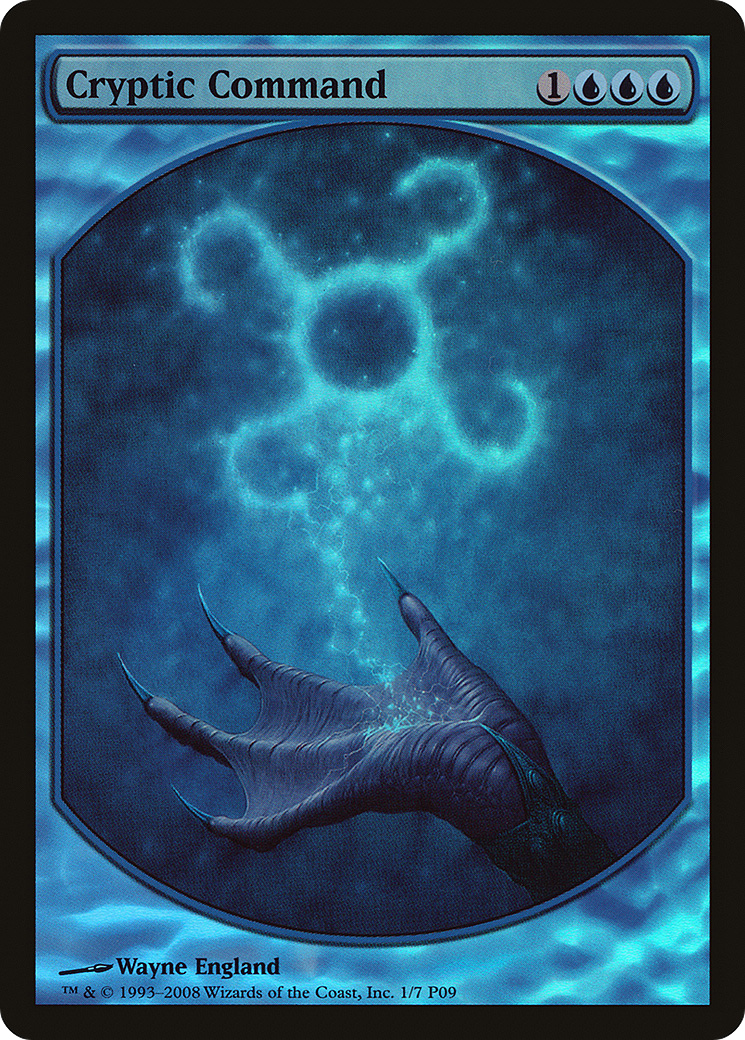
Fortunately, Birthing Pod is widely known in competitive circles — much more than Candelabra of Tawnos. Being generous, this puts the Secret Lair printing of Birthing Pod in a similar conceptual space as textless Cryptic Command. Birthing Pod may as well be textless, given how needlessly busy the card's text is — spelling out its color identity and over-explaining Phyrexian mana.
And yet, for all that visual excess, that tap symbol is still missing. It relies heavily on high Magic literacy to parse, so it may as well say nothing, like textless Cryptic Command. But it’s worse than that, because by having text at all it implies useful information — and the joke is the information isn’t useful. This might be fine for casual games in enfranchised playgroups with high Magic literacy, perhaps fine for top tables at events — but early tournament games featuring this card will face greater scrutiny for good reason.
It increases the opportunity for cheating against less experienced players. Candelabra of Tawnos manages to be worse, in fact, because someone playing with Secret Lair Birthing Pod may look more suspicious for it after all. Someone playing with Candelabra of Tawnos, meanwhile, enjoys plausible deniability. Unlike Birthing Pod, someone cheating with Candelabra can’t be expected to play a more accurate version.

I appreciate obscure cards and unconventional aesthetics, but vigilance against cheating matters too. At least textless Cryptic Command has the dignity to stay silent and not trip up a less familiar player by inviting them to ponder the meaning of ‘as though it were just played’ or time-wasting, redundant rules information. Some fans of angleshooting might deem that a valid competitive strategy, for whom showing up with a deck full of cards in different languages is fair game. It also curiously caters to disgruntled old-guard players who may want to gatekeep newer players by pressuring them to engage with dated rules text.
At least, as of the time of writing, looking up the Secret Lair Birthing Pod on Scryfall (though not Gatherer) provides this clarification, which someone felt the need to represent, I think quite understandably. If a printed card has missing information that requires looking up the card online to find a notice, that means very poor legibility. The silver lining is that this opens up design space for future cards to improve on earlier concepts.

Magus of the Candelabra has always appealed to me as a reinterpretation of the Candelabra of Tawnos design concept as a mana-accelerator creature. I like that it doubles down on the tapping cost and even adds summoning sickness. The flavor works, too. Poignantly , it alludes to something ancient, lost, and mysterious. Contentedly oblivious, yet practically potent.
It even has the coveted 1/2 statline for staying power against the likes of Orcish Bowmasters, quite ahead of its time! And what’s wrong with a little power de-creep? This is the sort of horizontal progression that’s good to see in a game. If The Fantasticar had been printed in the past, an in-universe, comparable change would surely have been welcome. The Time Spiral block had some design mana-accelerators that hit on this trend of reinterpreting old designs.

Bloodline Recollector by Cynthia Sheppard
The lovely design trend observed in the Reality Fracture deserves consideration. Unlike the original Planar Chaos color shifts, which allowed one-to-one translations of cards between colors like Prodigal Sorcerer and Prodigal Pyromancer, Reality Fracture is stricter about color-pie and power-level adherence and more flexible in design and flavor reinterpretation.

It’s what lets Ancestral Recall appear as Ancestral Craving, with the hoop-jumping prerequisite of being attached to Bloodline Recollector. Same goes for High Tide and Molten Tide on Pyre Rhymer. Arclight Phoenix finds a more difficult hurdle in Darklight Phoenix. Yet, even under these constraints, we find a very particular design expression which bucks the trend.

Simulacrum Shaper affirms that efficient resource acceleration is in ’s territory by costing mana fewer than generically-costed Solemn Simulacrum. Retroactively, it makes sense that Candelabra of Tawnos should cost at least generic mana if Magus of the Candelabra costs a single . Simulacrum Shaper has strengthened my conviction that I prefer the Magus of the Candelabra design.
If I may be entertained to present my own reinterpretations, I believe that can be useful for scrutinizing both The Fantasticar and Candelabra of Tawnos.
One quality of my retro-shifted, in-universe take on The Fantasticar is that it’s more excusable at a cost of mana. Since The Fantasticar’s ban, several players have observed that a Fantastic Four-themed card that creates four 4/4s as a reward for casting four spells should have a matching mana value of . If The Fantasticar were homegrown in MTG, I'd guess it’d come off less like an oversight.
Candelabra of Tawnos and The Fantasticar are both pretty fantastic designs, really. By that, I mean they’re both quite excessive in their efficiency.

The Fantastic Four by Yasmine Putri
Let’s imagine an alternate reality where these two designs switch places in time. The Fantasticar notably lacks a crew ability despite being a vehicle, which happens to make its design a little more plausible under old templating — though it would eventually have to be retrofitted in Oracle text with the Vehicle artifact subtype, as Thran Tome is with Book and Candelabra of Tawnos with the tap symbol and mono artifact erasure.
One additional consideration is that an in-universe The Fantasticar printed in an alternate 1994 may well have been banned shortly after release for the creature tokens' stat lines alone. It would most likely have been restricted the same as Candelabra of Tawnos—since it’s actually older than the Legacy format itself. Early Magic characteristically had underpowered creatures, and the tokens would more likely have been 1/1s instead of 4/4s, but I wouldn’t rule it out for the sake of the thought experiment.

Tarmogoyf by Justin Murray
WotC has shown tolerance for best-in-slot creature threats throughout its in-universe history, like Tarmogoyf or Delver of Secrets, and even oppressive artifact-creature designs like Phyrexian Dreadnought and Arcbound Ravager. I wouldn’t put it past them.
Conversely, if Candelabra of Tawnos were a fresh Universes Beyond print in 2026 of the same alternate reality, more apprehensive modern sensibilities toward resource manipulation would similarly see it banned or feature some limiting clause. From our familiar point of view, it’s easy to see the in-universe The Fantasticar being banned in an alternate past, and a Universes Beyond Candelabra being banned in the alternate present.
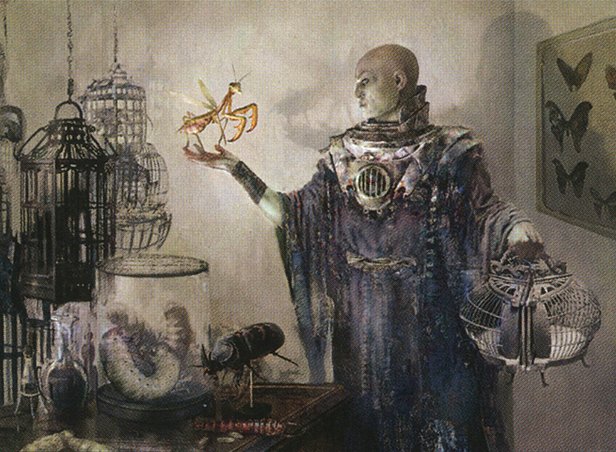
Delver of Secrets by Nils Hamm
Well, what about the viewpoint of extra-dimensional inhabitants looking back at our own reality? They might recognize our Universes Beyond version of The Candle Craft of Tawnos being banned in our present, but be surprised to find our in-universe version of their Fantastiportal went unbanned for 27 years.
We might explain this prolonged legality for our in-universe Candelabra of Tawnos by the card’s prestige and scarcity. Thus, Candelabra’s prestige over the years has served as a ceiling for its effect — “We don’t normally see artifacts untap lands at this rate, and so Candelabra of Tawnos is allowed to stand as an exception that proves the rule.”

Candletrap by Manuel Castañón
A similar rationale could plausibly excuse 27 years of legality for an in-universe The Fantasticar — ”We don’t normally see artifacts generate tokens at this size, and so The Candle Craft of Tawnos is allowed to stand as an exception that proves the rule.”
Regardless, Candelabra of Tawnos was restricted the same year it came out, and it’s easy to see The Fantasticar achieving the same feat. Being banned for four years after the inception of Legacy and dwelling mostly in obscurity because of its sheer scarcity would similarly insulate our in-universe The Fantasticar from ban attention.
The various problems caused by printing Universes Beyond cards aren't unique, and in-universe design mistakes have happened before. In some ways, blaming Universes Beyond lets WotC off easy.
Candelabra of Tawnos, despite its near 20-year legality in Legacy, has seldom shown up despite its high-impact design. From a more callous perspective, it may as well never have been legal, aside from a few blips on the radar. As printed, it probably belongs in Vintage or some alternative, perhaps a locked format or a problem-friendly Legacy variant truer to its name. If an eternal format is to stay competitively balanced and keep growing, certain old cards ought to retire.

High Tide by Amy Weber
I suspect the ban on Candelabra of Tawnos concerns older, more enfranchised players, who see it as a sign that old pet favorites aren’t as safe as once thought. It’s a confronting idea, and I think it should invite discussion about how older cards might find a home — a small minority of players may identify with the card and still want to run their old, reliable deck in a viable space.
I believe the widespread outcry over the ban of Candelabra of Tawnos mostly came from empathy for how easy it is to imagine your own old, reliable pet cards being banned once they're deemed an inconvenience to competitive balance. Still, we should remember that this can happen more organically than many of us assume. Sometimes, a ban is long overdue.
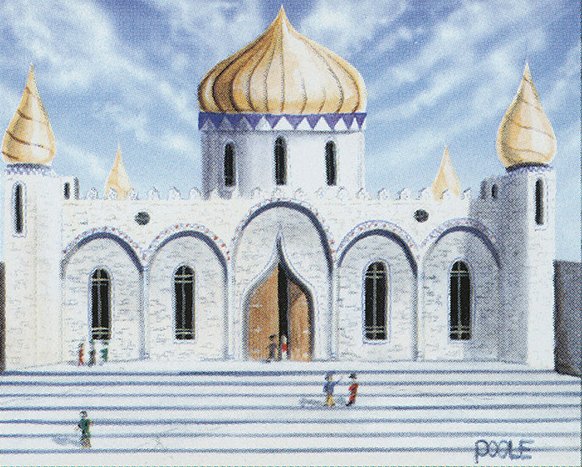
Library of Alexandria by Mark Poole
Candelabra of Tawnos precedes the birth of Legacy by just shy of two years and shares its initial pre-Legacy restriction with Library of Alexandria, which was printed the same year as Candelabra. I think it’s safe to say Candelabra of Tawnos is more in league with Vintage standouts than more familiar Legacy staples.
The Candelabra of Tawnos ban can be read as a sudden and abrupt panic ban. It can also be read as WotC holding off banning a card in Legacy — no, a Legacy card — for nearly 30 years since its Legacy unbanning in 1999 (it began on the initial banlist). If it lasted another three years, until 2029, to hit that milestone, what else would have to be banned around it? What designs would it keep from seeing print? All for an inevitable ban which perhaps should have come sooner.
The Shape of Legacy
What is the shape of Legacy to come? What do players want out of the Legacy format and eternal formats generally, whether locked or open? What apparent design intentions are conveyed by choice of bans? When we design and curate our own formats, we should ask ourselves the same questions.
Submit Your Article To Eternal Durdles
Subscribe to Eternal Durdles on YouTube! Subscribe to (R)Eternal Durdles on YouTube!
Featured image: Simulacrum Shaper by Gustavo Pelissari


